Showing posts with label nature. Show all posts

Friday, August 11, 2017

It Takes Work to be Creative!

My oldest daughter, the librarian and I made a quick trip to visit my younger daughter and her family this week to celebrate the 11th birthday of my granddaughter.  It's a longish drive -- 7 hours when including all the stops I need to make for stretch -- and so as many of you do, we listened to a book.

The book is titled Vincent and Theo, The Van Gogh Brothers by Deborah Heiligman.  (She found it on Hoopla.)  It's the story of the two brothers personal relationship and is drawn from nearly 700 letters written by Vincent to his younger brother.  We are a bit more than halfway through it and I'm in awe of the depth of their conversations with each other via the letters.  

I was reminded of an account of DaVinci I read 15 years ago.   He was never satisfied with his work and left behind enough UFO's to mentally cripple most people.  Yet, we admire his work and the legacy of ideas he left for our benefit.  He didn't know that would happen, he was working through ideas in his head and some worked but most didn't.  

We left off yesterday at the end of a chapter about a period in Vincent's journey to the paintings we know him for during which he was striving to expand his understanding of color. 
He had to learn to use color? 
What? 
He was an artist, isn't that part of their genetic make-up?

Of course it isn't.  It's a skill built through the creative process of learning.  Learning is experimenting, trying out ideas, imitating others who we admire -- in other words, it's work.   Vincent had some innate talent for drawing but he didn't rely on that to become an artist.  The author relates many examples of how he worked through the same drawing exercises repeatedly in an effort to learn and improve the skills of his trade.  

This particular chapter was discussing Vincent's discovery of complementary colors and he made the comment in a letter to Theo that using complementary colors "enriches the colors".  This occurred five years into his journey to become an artist.  Wow, I thought.  I use complementary colors to create contrast quite often but had not realized they also enrich one another.

I've been looking through some pictures I took last week on a walk around the perimeter of a large local meadow which is bordered on three sides by a lush forest of hickory, beech, and maple.  Just for fun, I've been naming the color schemes used by nature and focusing on the impact those color schemes have on what attracted me to photograph them.  

The meadow was alive with tiger swallowtail butterflies -- at one point, I could see nine fluttering over various parts of the meadow at the same time!!  
I took quite a few pictures but the ones I like best are when they were posed on this red-violet swamp milkweed with a rich green background of foliage.
The contrast of the complementary colors -- green and red-violet -- make the whole photo more vibrant.
These crabapples caught my eye as I walked past -- complementary colors!
I also made a mental note of how large they are this year -- time to make crabapple jelly!!
I think this shrub is in the dogwood family -- look how these berries stand out on their red stems. 
Compare that to how much less obvious these blue berries appear -- analogous colors.
Complementary colors -- does nature use them so things stand out?
Did I notice this grass because it stands out against the green background or because it was so different from everything around it?
Perhaps some of each? 
So if Vincent had to work at learning how to use colors, I should not be intimidated by the fact that using color is not intuitive for me.
It's work!
And it's work that I love!

Enjoy the weekend!
Mary


Wednesday, May 17, 2017

A Day Out With Botany Nerds

Mostly I bird -- but I also enjoy hanging out with "botany nerds".  Their obsession with plants and inclination to ask questions and focus on details feels comfortable!!
Tuesday, I joined a group of ONAPA members for a trip to a Northwest Ohio.

Our first stop was at the Castalia Prairie in the Resthaven Wildlife Area west of Castalia, Ohio!
This 60 acre prairie is commonly regarded as one of the best prairie remnants in the state harboring a number of rare plant species.  It was burned over this spring for the first time in several years -- if you aren't familiar with prairie management, a burn is good.  It knocks back woody species and maintains the open health of the habitat.
It was immediately obvious that the wildflowers in bloom were nothing with which I am familiar (no prairies on my side of the state).
The Star-Flowered Solomon's Seal was new to me and a charming little plant!
This was our main quarry -- the Showy White Lady Slipper orchid!  They were obviously enjoying the after burn of the prairie!
I was delighted to also spot a Yellow-breasted Chat!!
(That's a bird.)
Look how small this orchid is!?! 
This is a hybrid that also occurs in small numbers as a result of a population in the near-by woods of a yellow lady's slipper.  It is identified by it's maroon upper petals.
Then we were off for the ferry to Kelley's Island.  There are a number of islands in the western Lake Erie basin and Kelley's is the largest at just around 4 square miles.  It has been inhabited since the early 1800's and was the site of several quarrying operations and some winemaking. 
Today, the main attraction is relaxing and visiting one of the best preserved glacial grooves in the world. 
My first visit to the island was 1963 with my birding mentor, Gretta.  We rented bikes for the day and rode around the island birding (first orchard oriole sighting of my life) and visiting the sights.
Since then, there have been many trips to share a pleasant day with friends or family.
Basically, the island is a huge hunk of limestone (thus all the quarrying).
Unbeknownst to many in Ohio, a group of botanists have been working since 1989 to establish a viable population of the Lakeside Daisy to protect it from extinction as it is threatened on the mainland by development and quarrying. 
This is an old quarry site littered with limestone gravel and stone.
At first, you wonder "what's all the fuss about?"
Then you look down and see this plant thriving in what appears to be a completely inhospitable habitat.
There are now thousands of plants spread over 4 sights on the island and they are spreading outside the protected locations -- a good sign! 
It was exciting to see a success story!
So often, attempts to preserve a habitat or a species are thwarted on every side, but these tough little flowers have responded to the attention of a devoted group of botanists and their efforts are inspiring -- both the plants and the botanists!!
There is an accessible daisy preserve on the mainland in Marblehead, Ohio!  Even after the daisies have finished blooming, there are other uncommon and interesting plants to be seen such as Stiff Goldenrod and Dense Blazing Star.

Today, I'm staying home -- a little tidying up, some grocery shopping, blocking a quilt, some weeding in the gardens -- but it's back to the woods tomorrow for more birding!!
I just love spring!!

Mary


Friday, May 12, 2017

Birds, birds, birds . . . . but still stitching!

The migrating birds have had most of my attention for the past few days.  I live on the south shore of Lake Erie and most birds coming north for the summer don't like to fly across the lake, so the woods and marshes throb with a wide variety of birds for a few weeks in May, resting and feeding to make the final leg of the trip around the lake.  
I'm indulging in the luxury of being able to drop everything else and go look for them!!

I don't photograph birds as a rule -- my camera isn't equipped for it and I prefer to watch them through my binoculars.  But this young red-shouldered hawk was posing, so I took a couple pics of him earlier this afternoon.
The late spring wildflowers are blooming -- this jack-in-the-pulpit was one of the biggest ones I saw today. 
This white wild geranium caught my eye yesterday -- usually they are a pale red-violet color.
And the camas lilies are just beginning to bloom -- they are a lovely native and work well in garden settings, too.  They are available in some bulb catalogs and natural beautifully in moist areas.  Most of them are a pale blue, but we found a white one yesterday -- another rare sight in this region.
The woods in the park nearest to my home is quite wet and today, I came across several clumps of squaw root - it looks like fungi, but it's a native parasitic plant that grows on the roots of woody plants such as oak and beech trees. 
The sewing has slowed down a bit but I did get the courthouse steps blocks for the Long Time Gone SAL pieced while watching a delightful movie (A Bird of the Air) on my Kindle the other evening. 
Do you use Hoopla to borrow movies and audio books?
I just discovered Dirty Rotten Scoundrels in the list of available movies -- love that movie so think it will be a "watch" this weekend!
I cut all the strips for these blocks with one of Marti Michell's Log Cabin rulers -- the blocks just fly together using this method and working with the lengthwise grain strips keeps the blocks square and uniform!! 
I did a slight variation in the value placement making half of the blocks with the darks dominant and the others with the lights dominant.  Its another trick I learned from Marti and I like the balance better. 
I've also started to make the pineapple blocks -- there are quite a few of them and I'm using them as my "leaders and enders" while working on the everything else!
Using Marti's Pineapple Ruler set!!
 
Here are the Courthouse Steps blocks set into three bands as they will be used in the quilt.
Relying on value (light vs. dark) to make this cheerful set work!! 
Week 9's task was four chevron log cabin blocks -- I was a bit puzzled by the fabric pull on this one since there isn't any need to do "light vs. dark".  After some floundering around, I pulled assortments of fabrics that were compatible with the starter square for each block.
I was surprised in the end by how similar they look and no blues?
Hopefully it will look okay in the quilt! 
If not, they are pretty blocks and will find another home easily.
My last bird of the day this afternoon was lurking behind this stump as I walked along the trail.
Peek-a-boo!!  See that little glint of red?
And out popped a pileated woodpecker (about the size of a chicken).  He was busy tearing up a rotten log searching for insects.  Nice!!
One more day of intense over the top birding and then I need to reel it in for a few days and attend to my garden and house.  One benefit of staying outside all day is that I'm not having any trouble sleeping!!

I hope the weekend is a good one for you!!
Mary


Wednesday, April 19, 2017

A Little AWOL From the Studio

Spring is coming at me so fast here in Northeast Ohio -- a bit alarming in some respects!
I hate to miss any of my favorite spring sights, so have been out birding and walking for a couple hours everyday for the past two weeks.
My studio might be missing me?
 
Yesterday, I headed out to survey an area for birds that I have been visiting and keeping data for 7 years.  It is about 25 miles from home and in the end, it became a spontaneous almost all-day explore around with visits to a favorite perennial nursery and stops at several parks on my way home looking for FOY (first of year) birds and wildflowers.  If you follow me on Instagram (@hueymary), I apologize for the over-gramming of wildflower photos. 
 
Virginia Bluebells is one of our most beautiful wildflowers.  It is native and ephemeral (only apparent during the spring), blooming on forested flood plains.  The buds are lavender but the blossoms open blue and gradually "fade" to pink.  Typically, they bloom in May but they are quite early this year and since everything seems to be rushing along, it was important to take advantage of being near an acre-size patch along the Grand River.
Trout lilies are challenging to photograph since their flowers face down so I thought I'd try a "selfie" -- not so successful, but you can see what a beautiful day it was here.
They often tuck themselves up against the base of a tree which is the best photo op in my opinion!
 I found this yellow buckeye sapling starting to bloom -- perhaps two to three weeks earlier than typical.
The casual observer who enjoys pleasant weather will revel in it's beauty but a birder who is struggling to live with global warming is concerned about the hummingbirds returning in a couple weeks to find one of their early food sources out of bloom is alarmed.
Insects and plants respond to temperature as their signal to grow and produce. 
Birds are more keyed into length of day to migrate and breed.
So the insects can stay in cycle with flower bloom but migrating birds especially are struggling with early insect emergences which traditionally sustain them as they travel north.
 
And then I found this unusual toothwart -- leaves aren't typical -- so I took photos to take home and look up in one of my wildflower guides -- that didn't work.  Aunt Emma always scolded me about not "collecting" the right information to identify a plant -- it's not just about the flower, Mary!?!
Might have to go back there with the book in hand!
But I have spent my evenings in the studio and stayed on task with the Long Time Gone Sewalong.
I'm following Marti Michell's instructions and using her templates when they apply! 
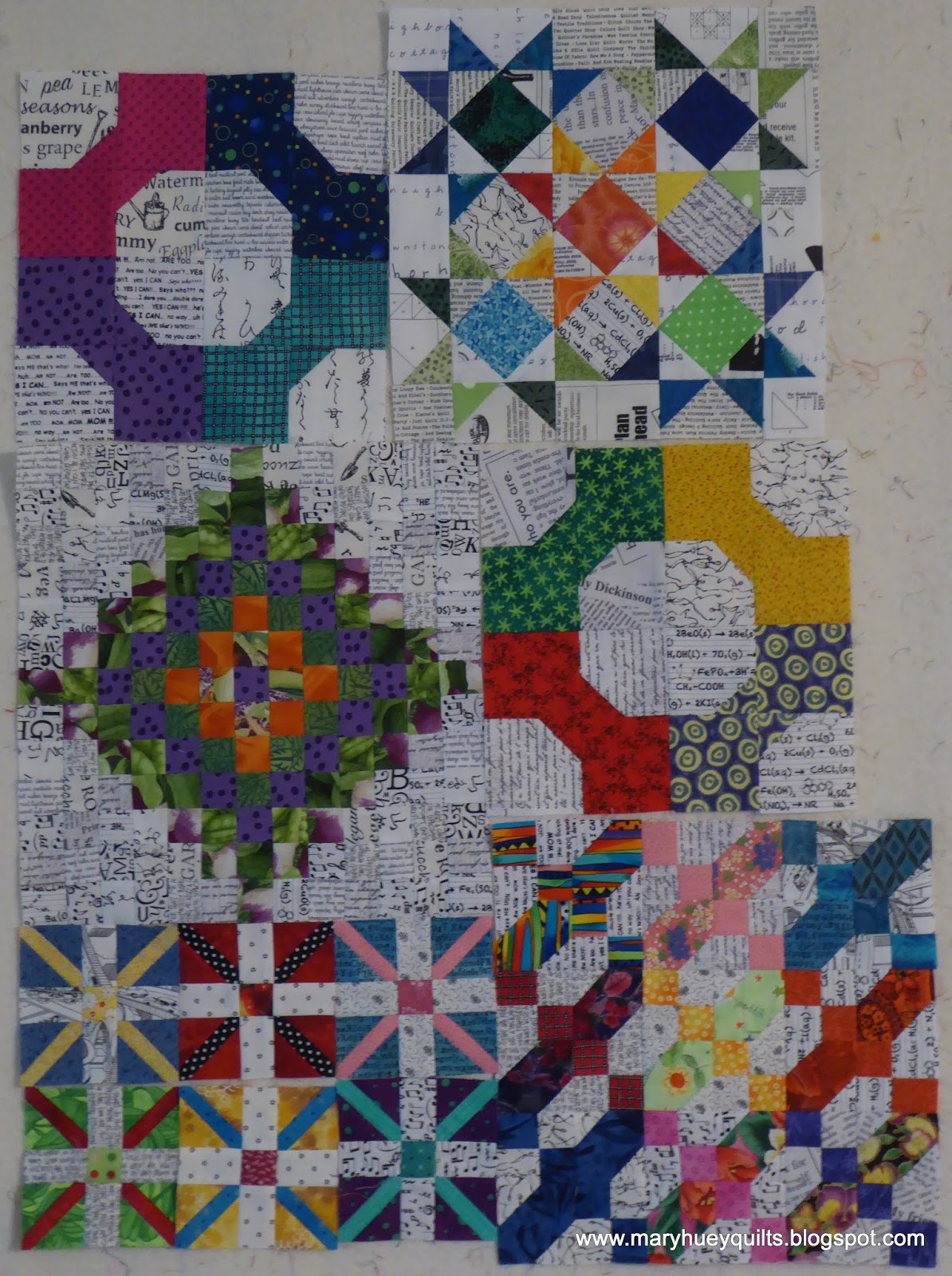
I auditioned several layouts for this block before stitching the units together. 
This is my final block -- so much fun to be finally using the pile of (mostly) text prints I've collected over the past couple years.  It would be a shame to have all of them and not use them myself!! 
For the Trip Around the World block, I focused on some "veggie" prints -- another biggish pile that I love using!!  The turnips around the outside edge are a new addition.  There wasn't enough of the peas or zucchini for the last green band, so I used both and alternated them.
I have put all the blocks up on the design wall to inspire progress and future fabric pulls for this project. 
I've also finished the bird blocks for Lorna at Sew Fresh Quilts' Jolly Christmas sampler.
I survived an attack of being temporarily (I hope) "diagram challenged" while making the cardinals.  I made a male (for my grandson) and a female (for my granddaughter) cardinal.
Here are the blocks so far -- there is another identical set.   
I'll probably sneak out again today once I've packed for my trip over to Westfield, NY tomorrow afternoon to speak to the local guild.  This puzzling picture is a reminder of where to find that red-head woodpecker nest hole and I MUST keep track of their progress!!
And migrating birds are arriving every night and must not be missed!!
And another wildflower will pop up . . . .
I hope you are loving the change of seasons in your part of the world -- it never ceases to engage my interest -- no matter how many times I've experienced it, there is always something I've not seen before. 
 
To the woods!!
Mary


Wednesday, November 23, 2016

Thanksgiving Week

After a balmy day last Friday, we had a weekend of cold weather and a bit of snow which brought the lovely part of fall to an end. The last leaves have turned golden and rust and we find ourselves on the edge of winter.
It's Thanksgiving week here in the USA and all that most everyone is thinking about is food and cleaning the house so my stitching time has been limited and poorly focused.  Facebook just reminded me that on Thanksgiving Day in 2012, we had dinner out on the patio and a red fox visited the back porch in the morning to clean up the cat's food.  We won't be having dinner out on the patio this year!!

My resident squirrels started their Thanksgiving feasting early and requisitioned the Halloween pumpkins -- I moved this one down by the bird feeders this morning to keep the mess off the back porch.  The little mob of dark-eyed juncos just ignore him as they search the grass for the cracked corn we throw out.
Sometimes a walk helps me focus (the refrigerator still needs cleaning before the big feast on Thursday) so I headed to a nearby wetland for a short late afternoon walk.  I've been helping a local group increase the survey birding along the local river corridor by visiting several different parks every week.  
The trail skirts the edge of an ancient dog-leg of the river that has attracted a pair of beaver who have re-engineered the area into an interesting pond and marsh.
The remnant of snow showed me that not only are there other folks (and dogs) who appreciate this rustic boardwalk through the marsh, it seems the white-tailed deer appreciate it as well.  It's breeding season for the deer right now and I've finally learned to pay attention during late afternoon walks -- not good to get between a buck and an attractive doe!
My walk yesterday afternoon yielded a new experience -- several coyotes howling not too far from the trail.  Upon returning home, I did some reading to see if breeding season is also beginning for them -- it's a bit early for breeding but not too early for dating.  I have to admit it was a bit unsettling and I was relieved to only spot black-capped chickadees this afternoon.  I was delighted that this one waited for me to get my camera out and set-up for a portrait.
He was foraging near these goldenrod galls -- the egg and larval case of the goldenrod gall fly.  The larva overwinters in the case and the fly hatches in the spring -- but not these!?!  Chickadees and Downy woodpeckers are the most likely culprits -- they had snacked on every one in this clump along the edge of the path.  You can read more about this HERE.
I returned home at dusk and watched to see if the cardinals were put off by the red yarn I added to my feeding pole this morning.  It's an attempt to keep the House Sparrows on the ground and out of the sunflower seed tray -- seems to have worked the first day though I wouldn't be surprised if the sparrows get over their trepidation before winter is over.  Surprisingly, the yarn doesn't seem to bother any of the other birds coming to the feeders.
Reorganizing my feeders today made me wonder if the Cornell University Feeder Cams are up and running for the winter.  They have three -- one at the lab in Ithaca, New York (click HERE), my favorite  located in Ontario, Canada (click HERE) which attracts birds we rarely get here in Northeast Ohio, and a hummingbird feeding station in West Texas (click HERE).  (If you are visiting any of these sites from other parts of the world, NY and Canada are in the Eastern North America time zone and Texas is in the Central time zone.) 
 
We are gathering a small group of family and friends, sharing the cooking duties, and looking forward to a quiet day of feasting and visiting on Thursday. 
Then with the house clean and lots of leftover food in the kitchen, I can spend the weekend starting my Christmas stitching!!
Enjoy the rest of your week!!
 
Mary