Showing posts with label monarch butterflies. Show all posts

Saturday, July 21, 2018

Summer Distractions!!

High summer is upon us here in Northeast Ohio!
It's a season of color, happy little discoveries, and comfortable memories.
These little blue flowers (I'm told it's a weed) grew alongside the back porch of my first childhood home and ever since I discovered them in my current home's garden, I allow them to grow where ever they appear just because they make me smile.
Suddenly on the 5th of July, I discovered Monarch butterflies were leaving eggs all over my backyard plot of milkweed so the new rearing enclosure that was a Christmas gift had to be quickly assembled!
Now my mornings begin with cleaning the enclosure, reviewing everyone's progress, and bringing in fresh food.  With close to 70 caterpillars at various stages and a few new finds almost everyday, it's a good hour or more of pleasant work.   I can't determine if all these eggs are the work of one female or several, but for about 5 days, every time I was outside, there was a Monarch in my yard -- such constant presence is new for me.  The females can lay 400 eggs and I'm pretty sure she did!!
Now at the 15 day point, I'm seeing a few new chrysalis every day and should be releasing butterflies by the end of July.   
These likely won't be the generation that makes the big migration to Mexico, but they will parent that generation so I'm excited to be able to release so many!  If you live in the area and would like to stop by and see all this in person, let me know!
Then there was the big "we got married" picnic that my son and his wife threw!!  Both families worked together to set up tents, mow the pasture, organize tables and coolers and lights.  My son (in the hat) and his "dude buds" smoked a whole hog, a local farm-to-table caterer did the sides . . . . 
. . . . . and I rounded up a load of flowers and a bevy of nieces to make the table bouquets!
In between all this enjoyment of summer outside, I got caught up in a knitting project!?! 
I discovered Marie Greene of Olive Knits this past winter -- her sweater designs are primarily knit top down and seamless -- my kind of knitting!!  She challenged anyone who was game to a 4 day sweater knit-along beginning July 1 with a new pattern, The Beekeeper's Cardigan.  During a tidy-up of my knitting supplies in mid-June, I re-discovered a bag of my mother's yarn -- enough for a sweater?  
I swatched to test my gauge and get a feel for the design.
You know where I'm going with this, don't you?
I did not finish in 4 days (but some gals did!?!) but if you follow my Instagam feed (@hueymary), you've seen progress photos.   This was the end of the two week knit-along -- I was at 44 hours at this point.  Today, I'm finishing the second sleeve and then will start the final ribbing bands. 
 It's been a delightful knit and I'm so pleased with the results.
I'll share a bit more about when I finish later this month!
I'm staying on my machine quilting schedule for the most part -- make steady progress every day -- though keeping tabs on this pot of "bush" cucumbers (they are now embracing the huge tomato plant in the adjacent pot) has been distracting.  It's behaving like a zucchini, hiding the fruit just under a leaf so that in spite of twice a day inspections, suddenly there's an almost too big fruit down there??
Then something has to be done with them -- refrigerator pickles this afternoon!
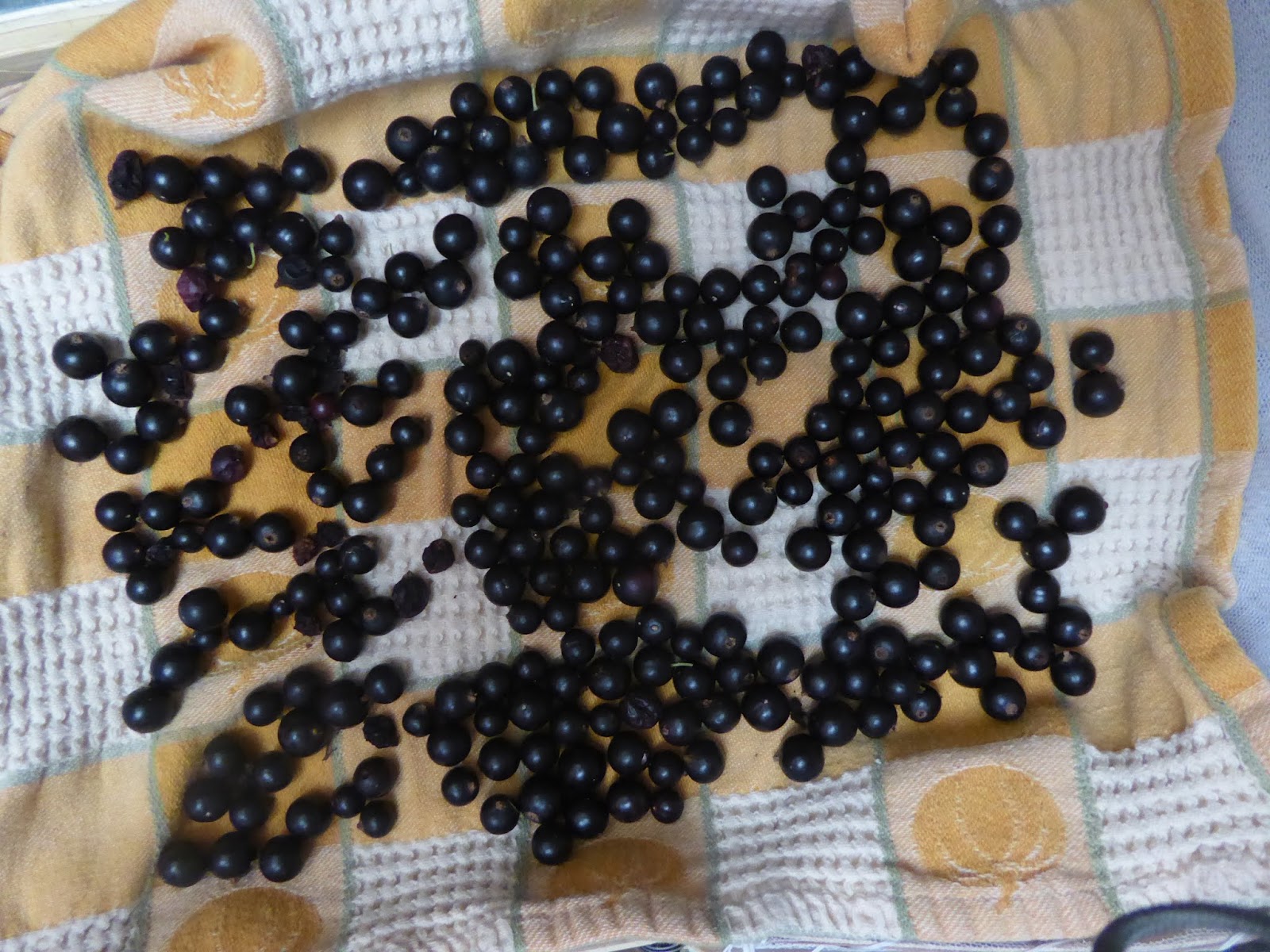
The black currants HAD to be harvested today -- I just have one bush so never enough to do anything significant.  This year, I'm going to try drying them like raisins -- should be either enough for a batch of scones (yum) or I'll use them for flavoring tea!
The drive to eliminate the invasive bindweed from this flower bed demands daily policing and on the morning tour four days ago, two cardinals flew out of the honeysuckle vine!  I looked more closely to see what bugs they have found on the vine -- they like big juicy bugs and can crack a beetle in a flash but no bugs!!  
They have built a nest!!
It's hard to see -- just a sloppy looking clump of grass and sticks right in the center of the picture that hopefully will last long enough to fledge their brood!
When I was out there working this morning, I was being watched!
The female has started to lay her eggs!!
According to Nests, Eggs, and Nestlings of North American Birds by Baicich and Harrison, she will lay from 2 to 5 eggs and begin incubating once the 3rd egg is laid (birds generally lay one egg a day).
Incubation takes 11 to 13 days!  
Can you see her?
So the next few weeks will be filled with lots of cardinal watching -- I've always wanted to discover a cardinal nest!!
FUN!!
While it's hard to be inside on the nice days, I am working on my "birth year" temperature quilt! 
 It just took an interesting turn, too . . . . . . all will be revealed soon!
 I'm keeping up with the #fussycuttingsewalong hexie project on Instagram.  I am currently piecing this large motif as the center of my masterplan for the 52 hexie flowers that will result from the group by the end of the year.  I've done some preliminary auditioning and feel (pretty) confident about the plan.
As soon as the center is finished, I'll share it here. 
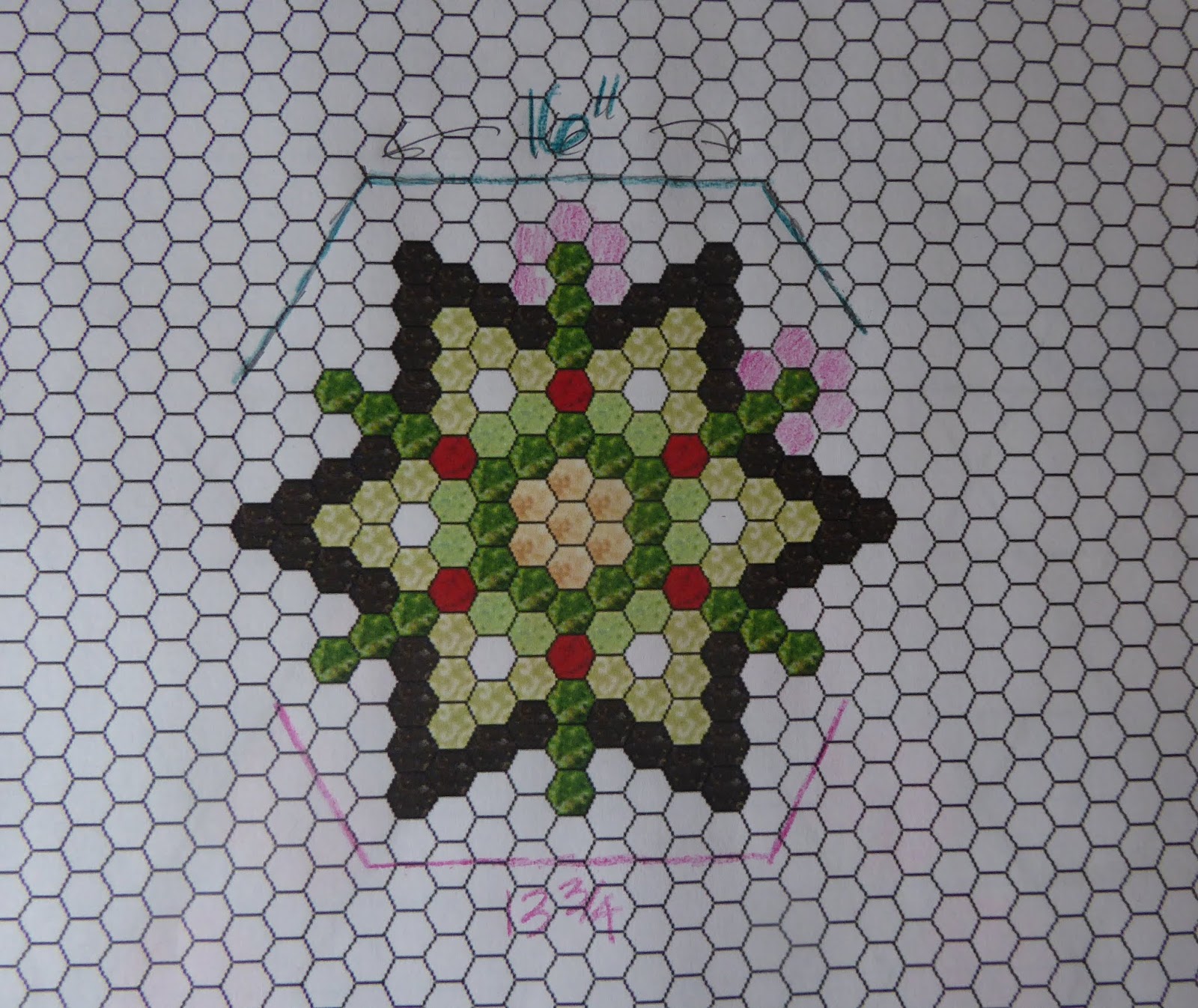
If you don't see it, you know it didn't work after all!

I'm still waiting for ripe tomatoes and I hope this current season is providing you with lots of enjoyable moments, too!
Mary

NOTE:  I still am not getting comments e-mailed to me so I can't e-mail you a response but I do appreciate your comments and am reading them just the same!!  (Yes, I tried the fix several times and will keep trying.)


Friday, August 7, 2015

Monarch Butterfly Season Again

The studio "tidy-up" continues at a slow pace.  Our weather is drawing me out into the garden and it's that interesting, exciting time of the year when fostering up monarch butterflies becomes one of my primary activities.

I've managed to find a few eggs on the undersides of my common milkweed plants.
This year, I've left them on the plants watching every morning for this -- the tiny hatchlings eating a hole for their first meal. 
The netting shelter is hanging on the back porch with a bouquet of milkweed that gets changed every morning or more often with the gang munching away. 
It only takes about 10 days to go from that tiny creature that is hard to see to these fat ones that are hard to miss!! 
And when they get this size, we know it won't be long!! 
Soon they'll head up to the top of the enclosure. 
Once they attach themselves to the ceiling, they hang for about a day.
And the next time I look -- a chrysalis!! 
There are seven in my enclosure right now and a new batch of wee ones (10) that I discovered a couple evenings ago while watering and peering under leaves! 
Next week we'll be able to begin to release the first batch as they emerge. 
Because monarch butterflies migrate, they get a lot of media attention and their sharply decreasing numbers have alarmed many scientists.  Right now, there is a new initiative launching through the central USA to replant wild summer flowers such as the milkweeds to reverse the trend for monarchs and other insects. 

There's lot of information on the internet but my favorite source is Monarch Watch.  If you are on Facebook, you can also look for the page "Milk the Weed" -- it has lots of interesting links if you are interested in increasing the number of native plants and insects in your yard which will usually lead to more birds in your yard.   And this is a link to a list of native plants that various butterfly caterpillars eat for the USA!!

But you'll have to give up the pesticides and the herbicides -- you can plant the most spectacular butterfly garden in the world and it's all for naught.  I wish more of my neighbors would abandon their green deserts and join me in enjoying the insects and all they do for us!!

Back to the tidying!!

Mary Huey

My hanging enclosure for rearing the caterpillars comes from http://www.educationalscience.com/index.php/


Tuesday, July 29, 2014

Monarch Feeding Frenzy

Back in the fostering enclosure, the Monarch caterpillars are giving us a run for the money.  There are currently five feasting on the milkweed stalks and it doesn't take long for them to strip them clean!!
The feeding caterpillars I have right now all hatched the same day and you can see they are getting to a good size -- about 2" long.
Are these two arguing about who gets to finish off this leaf? 
Before lunch.
After lunch.
This morning, two more have moved up to the top to begin the transformation to a chrysalis -- it seems to take about 24 hours.  I expect the last 3 to follow suit by the end of the day.
Then the top of the enclosure will be bejeweled with 9 of these gems.
Out in the milkweed patch, I've been keeping an eye on the spider nest -- the babies are growing -- they are now twice the size they were when I first found them, but the adult is no longer on the same stalk.  Really, they are bigger.
And I discover this amorous pair -- Milkweed Longhorn Beetles.  There are 8 species of this beetle in North American.  According to my little guide book, they are just coming into their season -- being more prevalent in August.  The adults feed on the tips of the leaves -- just like the picture?!? 
And I think the lightening bugs are having a good summer -- cool and wet might be their favorite weather.  I found this one hanging out until dusk when lightening bugs come into their own.  Did you know the adults don't eat?
Thanks to my friend, Carol, who also fosters for helping my daughter Alison keep them fed while I was off teaching and relaxing last week.  Alison released our first one a week ago today -- hopefully he/she is off making more Monarchs who will be destined to make the big migration south.

If you are enjoying this series on fostering the Monarchs, I hope you will let a few more weeds grow in your yard to provide food for caterpillars of butterfly species.  It's all well and good to plant nectaring plants for butterflies, but those plants aren't necessarily caterpillar food -- each species has specific plants it needs.  I let the violets overrun some of my flower beds to provide food for fritillaries and I've just planted service berry which I hope will attract red-spotted purple.  There is fennel and dill for the swallowtails.  Wild cherry and tulip trees host other species.  Here is a link to a site that lists a number of host plants for caterpillars -- check it out and inventory your neighborhood.  Then add some plants to your garden to expand the potential!  There's more to loving butterflies than just admiring them.

I hope the sun is shining in your part of the world!

Mary Huey

Here are links to my previous two posts about this adventure!


Thursday, July 17, 2014

Monarch Butterfly Fostering -- Day 11

Part of being a Monarch caterpillar is foraging for food and since I'm holding them "captive", I'm responsible for the foraging.   When I first started doing this several years ago, it meant a daily bike ride to a milkweed patch about 1/2 mile from my home.  These days, I just walk around the corner of the house!  As I choose a stem of milkweed to bring to the enclosure, I look around for more eggs -- the white dot on the left leaf is an egg.  They are laid one at a time, rarely on the same plant or even the same leaf -- increases their survival rate!  The little speck on the right hand leaf is a caterpillar emerging from the egg -- talk about being in the right place at the right time!
This leaf is in my nursery box and yesterday, three more caterpillars emerged.  They begin to feed immediately and the little holes in the leaves often leads me to a newly emerged one.  The lower hole in the photo below is very typical of a first feeding zone -- the caterpillars are attached by a silky strand and feed in a circle leaving a donut shaped hole. 
During one of my food gathering forays a couple days ago, I stumbled onto this spider.  She was spread out flat against the stalk and if she was green I would not have noticed her.
As I took her picture, she moved around the stalk but it was obvious that she had no intention of leaving the area.  She's over an inch long.
And then I discovered the reason for her determination.  At the top of the stalk was this cluster of a hundred or so baby spiders -- obviously her brood.  It's been three days since I discovered them and the adult spider is still there.  So I looked in my little guide book and sure enough, it's a Nursery Web Spider.  Isn't that interesting?   It will be interesting to see how long the group stays together and how long she stands guard.
Back in the fostering enclosure, the three oldest caterpillars are eating voraciously and as you can see in the next two pictures, they vary in length from 1" to almost 2".  The biggest one will likely morph into a chrysalis in the next couple days.
The fresh stalk of milkweed is wet because I wash them off a bit to remove other insects that might be predators on the caterpillars.  With three this size, the stalk will be stripped bare by early afternoon and I'll need to collect another stalk. 
There are seven tiny ones in the nursery box right now -- you can see six of them in this photo -- I provide fresh leaves a couple times a day.  They seem to prefer to feed on the underside of the leaves when they are this size -- a protective instinct I image.   
Hopefully by the middle of next week, they will all be in the enclosure happily munching through my milkweed plants!  My purpose in fostering them is two fold -- hopefully, I'm enabling more caterpillars to reach maturity and I'm fascinated by it!

Mary Huey


Sunday, July 13, 2014

Monarch Butterfly Fostering

It was just a week ago that my daughter, Alison discovered the first Monarch caterpillar in our milkweed patch!!  It wasn't even an inch long and in just one week, it has attached itself to the top of the fostering enclosure assuming the J-position that is the beginning of the transformation into a chrysalis. 
By the end of the afternoon, the transformation was complete and it looks like a piece of jade with pindots of gold.  In about 10 days, it will emerge as an adult monarch butterfly.  As I understand it, this generation of butterflies will be the parents of the generation that migrates south in September and October.
And there has been progress in the "hatchery".  It is populated with three toddlers that vary in age from 2 days to 7 days.  There's a shy one working the underside of that center leaf.  They will be moving into the fostering enclosure once they reach 1" in length.  (The little black dots are poop.)
In the meantime, I'm watching for more eggs as I harvest leaves and stalks to feed the fostering caterpillars.  I have three more eggs.  This patch was beat down by the heavy rains earlier in the week, but most of the stalks have lifted back up.  About half the plants are in bloom and if you've never enjoyed the fragrance of common milkweed, seek some out for a whiff!.  It's one of my top favorite fragrances!
In my oldest perennial garden, I have a patch of swamp milkweed. 
It's a bit tall for the bed and it doesn't have the fragrance, but I love the flowers.
The individual flowers stand upright unlike the common milkweed which hangs down.  I was reading my little guidebook this week and the fertilization process is very unique for flowers.  Each flower can generate one seedpod which will have hundreds of seeds.  Thanks goodness not every flower is fertilized! 
Both milkweed patches are loaded with a wide variety of insects!  There must be a half dozen different species of bees visiting the flowers.  I love these big bumble bees!  The book says that bumble bees are "hairy" and carpenter bees which are about the same size are "hairless".
And have you ever seen this insect?  It looks similar to a photo in my book of a thick-headed fly though there are 67 species in North America -- they are bee and wasp parasites, so it wasn't there for the flower nectar.
And this is an Earwig -- there are 18 species some of which will prey on caterpillars.  I had a tough time photographing this fellow and the book says they are nocturnal -- that explains his reluctance to stay out where I could see him.
I enjoy fostering these caterpillars so much and thought you might enjoy following along!

Mary Huey